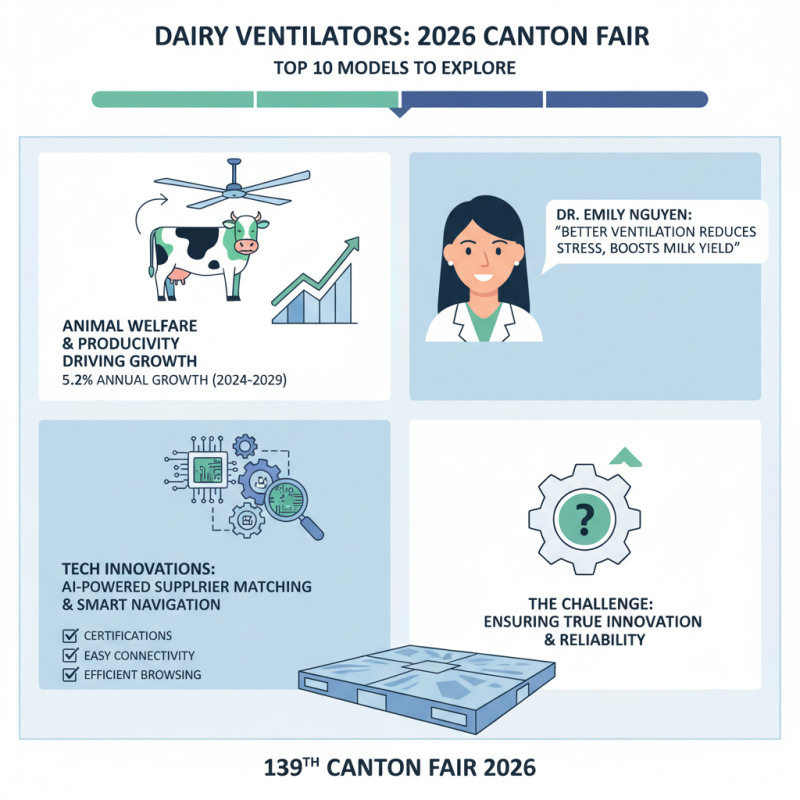
As the 2026 Canton Fair approaches, the spotlight is set to shine on innovative technologies, particularly in the dairy sector. The fair will showcase the latest advancements in dairy hanging ventilators, crucial for maintaining optimal conditions in livestock housing. Expert Dr. Emily Nguyen states, "Inadequate ventilation can lead to increased stress in livestock, affecting milk production."
The dairy hanging ventilator market is projected to grow significantly. Reports suggest an annual growth rate of 5.2% in the next five years. This is largely driven by the demand for better animal welfare and productivity. The 139th Canton Fair will feature advanced solutions for farmers seeking to enhance their operations.
Furthermore, the introduction of AI features will revolutionize how manufacturers and buyers connect. Attendees can now easily find suppliers with specific certifications. The use of smart navigation will streamline the experience across the extensive venue. Yet, there remains a concern: not all suppliers live up to the technology’s promise. Continuous improvement is essential to ensure true innovation in the dairy hanging ventilator industry.
Dairy hanging ventilators play a vital role in maintaining optimal conditions in dairy facilities. These systems improve air circulation, which is crucial for livestock health. Proper ventilation reduces moisture and ammonia buildup, ensuring a comfortable environment. Farmers often overlook this aspect, leading to diminished animal welfare and productivity.
The efficiency of these ventilators directly impacts dairy operations. Effective airflow helps regulate temperature, preventing heat stress in cattle. It's essential to choose the right model for specific needs. Some designs may not fit every barn layout. Exploring various options at events like the Canton Fair can provide insights into innovative solutions.
Many farmers face challenges with existing systems. Some ventilators may be too noisy, disturbing both animals and workers. Others might lack adequate airflow, leading to stale air pockets. Recognizing these issues is key to making improvements. Evaluating new models can help identify better-performing alternatives that enhance the overall environment in dairy barns.
When exploring dairy hanging ventilators, key features are vital for efficiency and performance. Effective airflow is crucial. Look for ventilators that can achieve a minimum air delivery of 15,000 cubic feet per minute. This is essential for maintaining proper temperature control in dairy barns.
Moreover, consider noise levels. Many ventilators exceed 70 decibels, which can stress livestock and hinder productivity. A quieter model, ideally under 60 decibels, is preferred. Energy efficiency also matters. Reports indicate that ventilators using variable frequency drives can reduce energy costs by up to 30%. These models adjust speed based on real-time conditions, thereby lowering waste.
Durability and maintenance ease should not be overlooked. Dairy facilities often face harsh environments. Galvanized steel or high-grade plastic parts provide resilience. Regular maintenance is necessary, but designs that allow easy disassembly are more user-friendly. Some models have filters that require frequent cleanings, adding to the upkeep effort. Overall, the right choices in ventilators can significantly impact dairy farm productivity and animal welfare.
The 2026 Canton Fair will showcase remarkable dairy hanging ventilators. These products are designed to enhance airflow in dairy farms. Efficient ventilation is crucial for livestock health. It reduces heat stress and improves milk production.
One standout feature is the advanced fan blade design. This increases airflow while minimizing energy consumption. Many manufacturers emphasize sustainability in their designs. Some models boast smart technology for real-time monitoring. However, not all models live up to expectations. Some lack the promised efficiency. It’s essential to evaluate specifications carefully.
Visiting the fair, you may see various sizes and configurations. Some are robust and suited for large barns. Others are compact for smaller spaces. Potential buyers should note installation challenges. Attention to detail can equate to better performance. Choosing the right ventilator involves more than just price. It requires thoughtful consideration of your specific needs.
Dairy hanging ventilators play a crucial role in maintaining optimal environments in livestock facilities. According to a recent industry report, effective ventilation can increase dairy cow productivity by up to 10%. Proper air circulation reduces heat stress, which is vital for milk production.
In 2026, the Canton Fair will showcase top models that combine innovative designs with superior performance. Many models claim energy efficiencies exceeding 85%, which reduces operational costs significantly. However, the variance in airflow rates can be significant. Some pumping systems only reach half the efficiency of their competitors, leaving room for improvement.
In addition to cooling, these ventilators must minimize noise. Studies indicate that excessive noise can stress livestock, leading to reduced output. Many models currently lack this feature. The industry is evolving, but there are still technical challenges to overcome. The focus on durability versus initial costs often leads to compromises in performance. Finding the right balance will be key for future innovations.
| Model | Airflow (CFM) | Power Consumption (W) | Noise Level (dB) | Efficiency Rating |
|---|---|---|---|---|
| Model A | 3000 | 150 | 55 | 4.5/5 |
| Model B | 2800 | 140 | 58 | 4.2/5 |
| Model C | 3200 | 160 | 50 | 4.7/5 |
| Model D | 2900 | 155 | 53 | 4.3/5 |
| Model E | 3300 | 165 | 48 | 4.8/5 |
| Model F | 3100 | 145 | 60 | 4.4/5 |
| Model G | 3400 | 170 | 52 | 4.9/5 |
| Model H | 3000 | 155 | 57 | 4.1/5 |
| Model I | 3100 | 150 | 54 | 4.3/5 |
| Model J | 3300 | 160 | 49 | 4.6/5 |
As the dairy industry evolves, so does ventilation technology. Innovations in this field are crucial for maintaining animal health and improving productivity. In 2026, the Canton Fair promises to showcase significant advancements, focusing on energy efficiency and airflow control. These innovations can help regulate temperature and humidity, creating a comfortable environment for dairy animals.
Emerging technologies are often experimental. Some designs may not perform as expected in real-world conditions. For instance, newer ventilators may struggle to adjust effectively to changing weather. Yet, these challenges can drive further improvements. The focus on smart systems is apparent, with sensors monitoring air quality and animal comfort. However, integration with existing dairy farm setups can be a complex issue. Understanding how these systems interact remains essential for achieving desired outcomes.
While the future is promising, practical considerations are vital. Farmers often face budget constraints. They must weigh the benefits of investing in new technologies against their operational costs. The balance between innovation and feasibility will shape the future of dairy ventilation. This exploration at the Canton Fair could reveal valuable insights and solutions to those challenges.
: They help maintain optimal environments in livestock facilities and improve dairy cow productivity.
It can increase productivity by up to 10% by reducing heat stress.
Many models claim energy efficiencies exceeding 85%, reducing operational costs significantly.
Some models only reach half the airflow efficiency of their competitors, indicating room for improvement.
Excessive noise can stress livestock, leading to reduced milk production and overall output.
Innovations will focus on energy efficiency, airflow control, and smart systems for monitoring air quality.
They may struggle with real-world performance and adaptation to changing weather conditions.
Farmers must balance the costs of innovation with the benefits to operational efficiency.
They will use sensors to monitor air quality and animal comfort, enhancing overall conditions.
Understanding the interaction between new technology and existing dairy farm setups is crucial.
The article "Top 10 Dairy Hanging Ventilators to Explore at 2026 Canton Fair" provides a comprehensive overview of the significance of dairy hanging ventilators in maintaining optimal conditions in dairy production. It outlines the key features to consider when selecting these ventilators, such as energy efficiency, airflow capabilities, and durability. The piece also highlights the top ten models showcased at the upcoming Canton Fair, analyzing their performance and efficiency to assist potential buyers in making informed decisions.
Furthermore, the article delves into future trends in dairy ventilation technology, emphasizing innovations that promise to enhance airflow management and sustainability in dairy operations. As the industry evolves, understanding the advancements in dairy hanging ventilators will be crucial for producers seeking to improve livestock health and productivity while adapting to new technologies.

WANJIA